Tag: Weekly Bible Readings

  • You’re Not Vouching for Anything

    You’re Not Vouching for Anything

    Recommending most things comes with some risk. You suggest a diet, a productivity app, a book that changed how you think, and if it doesn’t land the same way for the other person, that’s on you a little.

    This is different.

    There’s nothing to oversell here. No promise about what it’ll do for someone, no outcome you’re putting your name behind. It’s just a structure for reading the Bible. Either it’s useful to someone or it isn’t, and that has nothing to do with you.

    That makes it an easy thing to pass along. You’re not telling someone this will change their life. You’re just handing them a plan that’s worked for you, with no expectation attached.

    If it fits, they’ll use it. If it doesn’t, nothing was lost by mentioning it.

    Just send them this page from your phone, they can sign up below if they like it:

    Start With This Week’s Readings

    We respect your email privacy

    By submitting, you consent to receive emails from His Word Together, including blog posts and updates. You may unsubscribe at any time.

  • Behind Compared to What?

    Behind Compared to What?

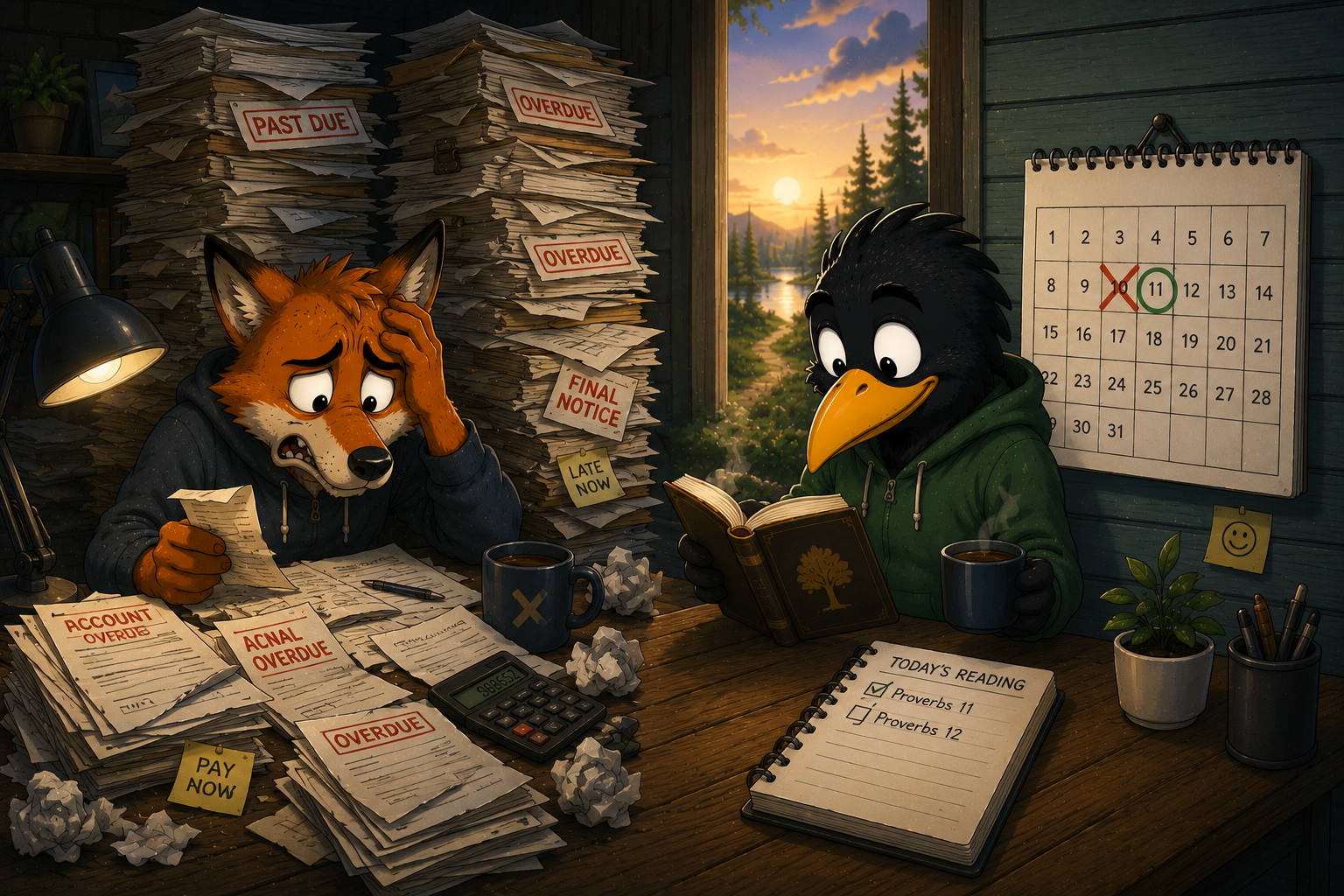
    People say they’re behind on their Bible reading, but behind compared to what exactly?

    There’s no other reader to measure against. No version of you that did it perfectly this year that you’re now trailing. The only thing “behind” could mean here is behind some imaginary schedule where nothing ever interrupts you, and that schedule never existed for anyone.

    Real weeks have sick kids, late nights, trips, days that fall apart for no good reason. A plan that assumes none of that happens isn’t a realistic plan. It’s a trap that makes you feel like you failed at something nobody could have actually done.

    This one doesn’t work that way. There’s nothing to be behind on, because there’s no finish line you’re racing toward. You’re not behind. You’re just wherever you are, and the next chapter is right there waiting whenever you pick it back up.

    Stop comparing yourself to a version of the year that doesn’t exist. Just read today’s chapters.

    If you’d like the weekly readings delivered to your inbox each Sunday, you can sign up below.

    Start With This Week’s Readings

    We respect your email privacy

    By submitting, you consent to receive emails from His Word Together, including blog posts and updates. You may unsubscribe at any time.

  • Digital vs Print

    Digital vs Print

    It doesn’t matter which one you use.

    Some people like having an actual Bible in hand. Turning pages, writing in margins, the weight of it. Others read on a phone or tablet because it’s already in their pocket and there’s nothing else to carry around.

    Both work fine for this. The plan doesn’t care what format you’re reading in, and neither do I.

    If you’re inclined toward print, a basic copy works. You don’t need a study Bible loaded with notes and cross-references, since the point here is reading the text without anything stacked on top of it. If digital is easier, any Bible app with the right translation will do the job.

    The one advantage digital has is convenience. If your phone is already with you most of the day, the reading is too. That removes one more excuse for skipping it.

    The one advantage print has is fewer distractions. No notifications, nothing else open in another tab.

    Pick whichever one you’ll actually use. That’s the only criteria that matters.

    If you’d like the weekly readings delivered to your inbox each Sunday, you can sign up below.

    Start With This Week’s Readings

    We respect your email privacy

    By submitting, you consent to receive emails from His Word Together, including blog posts and updates. You may unsubscribe at any time.

  • No One Will Ask You About It

    No One Will Ask You About It

    There’s no discussion group waiting for your take. No one is going to ask what you thought of yesterday’s reading or quiz you on what happened in the chapter.

    That changes how you read.

    When you know you’ll have to explain something, you read differently. You’re scanning for the takeaway, the thing you can say out loud later to prove you did it. That’s not a bad way to read, but it’s a different activity than just reading.

    Nobody is checking here. You can read a passage, not fully understand it, and move on without needing to produce an answer for anyone. You don’t owe an explanation to a group, a pastor, or an app.

    That sounds like it would lower the stakes, and it does. It also removes a layer of performance that gets in the way more often than people realize. A lot of reading turns into rehearsing what you’ll say about the reading. Without an audience, that goes away.

    What’s left is just you and the text, which is the part that was supposed to matter in the first place.

    If you’d like the weekly readings delivered to your inbox each Sunday, you can sign up below.

    Start With This Week’s Readings

    We respect your email privacy

    By submitting, you consent to receive emails from His Word Together, including blog posts and updates. You may unsubscribe at any time.

  • You Already Did the Hard Part

    You Already Did the Hard Part

    Finding a reading plan that actually sticks is harder than it sounds.

    Most people try two or three approaches before something works, if they get that far at all. A lot of them quit before finding anything, not because they’re not interested, but because picking the right structure on your own takes more effort than just starting.

    You already went through that. You found something that works for you and you’ve stuck with it.

    That’s the part most people are stuck on. Not motivation. Not interest. Just the absence of a starting point that doesn’t require figuring everything out themselves.

    You can hand someone that starting point in one text message.

    Just send them this page, they can check it out and sign up if they like:

    Start With This Week’s Readings

    We respect your email privacy

    By submitting, you consent to receive emails from His Word Together, including blog posts and updates. You may unsubscribe at any time.

  • Does the Order Matter?

    Does the Order Matter?

    It’s one of the first questions people ask.

    Should I start at Genesis? Do I need to read it in order? What if I skip something? Am I doing it wrong?

    The short answer is no, the order doesn’t matter — but the reason most people ask is that they’re trying to figure out the right way to do this before they start. And that question, more than anything else, is what keeps them from starting at all.

    This plan handles it for you.

    You don’t have to decide what to read. You don’t have to map out a sequence or research reading plans or figure out where the Old and New Testaments connect. The structure is already there.

    Proverbs follows the calendar. One chapter, every day, matching the date. The weekly readings move through the rest of Scripture steadily, a little at a time, in a sequence that holds together across the year.

    You just follow along.

    If you miss time and rejoin, you pick up where the plan is — not where you left off. If you don’t understand a passage, you keep going. If something doesn’t make sense now, it often does later once more of the surrounding text becomes familiar.

    The order matters less than the consistency.

    Read what’s in front of you. Come back tomorrow. Do it again.

    Keep reading.

    Start With This Week’s Readings

    We respect your email privacy

    By submitting, you consent to receive emails from His Word Together, including blog posts and updates. You may unsubscribe at any time.

  • They Won’t Go Looking for It

    They Won’t Go Looking for It

    Most people who want to read the Bible more consistently never do anything about it.

    Not because they decided against it. They just never found a place to start that felt manageable, and eventually the idea faded into the background with everything else they were going to get around to someday.

    They’re not going to search for a reading plan. They’re not going to stumble across this site. If it gets in front of them, someone has to put it there.

    That’s the only way it works.

    You’ve been reading consistently for a while now. That’s not common. Most people who say they want to do this don’t. If you know someone who’s been saying it for years without it happening, they’re probably not lacking motivation. They’re lacking a simple place to start.

    This is that.

    You don’t have to pitch it or explain it. Just send the link and let them decide. They can sign up below if they like.

    HisWordTogether.com

    Start With This Week’s Readings

    We respect your email privacy

    By submitting, you consent to receive emails from His Word Together, including blog posts and updates. You may unsubscribe at any time.

  • Summer Actually Makes It Easier

    Summer Actually Makes It Easier

    Most people assume summer is going to be harder.

    The schedule changes. Travel happens. Routines that worked in March don’t hold up in July. So they brace for it, and a lot of them quietly stop reading until things settle back down in September.

    That’s the wrong read on the situation.

    The structure that makes consistency hard in a normal week is also what makes it fragile. A fixed morning routine works until something disrupts it, and then you’re off for a week waiting to get back on schedule.

    Summer removes a lot of that rigidity. The days are looser. There are more odd windows of time, more flexibility about when things happen. Twenty minutes or less most days fits into a lot of places that wouldn’t exist during a regular Tuesday in February.

    The people who fall off in summer are usually waiting for their normal routine to come back. The people who stay consistent realize the reading doesn’t need the routine. It just needs a few minutes, and summer tends to have those.

    If you’d like the weekly readings delivered to your inbox each Sunday, you can sign up below.

    Start With This Week’s Readings

    We respect your email privacy

    By submitting, you consent to receive emails from His Word Together, including blog posts and updates. You may unsubscribe at any time.

  • How Long Does It Take?

    How Long Does It Take?

    Less time than most people expect.

    Proverbs has 31 chapters — one for each day of the month. Most of them take about five minutes to read.

    The weekly readings are four passages spread across the week. On the days you have one, you’re looking at around twenty minutes total. On the days you don’t, it’s closer to five.

    That’s it.

    No long sessions. No blocks of time you have to carve out. Nothing that requires rearranging your morning to make room for it.

    It fits into a commute. Into a lunch break. Into the ten minutes before you go to sleep.

    The reason most people don’t read the Bible consistently isn’t that they lack motivation. It’s that they picture something bigger than it actually is. An undertaking. Something that requires preparation and focus and time they don’t have.

    It doesn’t.

    It’s twenty minutes on a reading day. Less on the others.

    The plan is already laid out. You don’t have to figure out what to read or in what order.

    You just open it.

    Keep reading.

    Start With This Week’s Readings

    We respect your email privacy

    By submitting, you consent to receive emails from His Word Together, including blog posts and updates. You may unsubscribe at any time.

  • Sometimes Easy Matters More Than Deep

    Sometimes Easy Matters More Than Deep

    A lot of good intentions die because there’s too much friction at the beginning.

    People think they need the right Bible, the right plan, the right understanding, the right starting point, the right amount of time.

    So they keep delaying it while trying to “set it up correctly.”

    Sometimes easy matters more.

    Open the reading.
    Read the chapter.
    Come back tomorrow.

    That’s enough to get moving.

    A lot of habits become sustainable not because they’re intense, but because they’re simple enough to repeat without much resistance.

    That’s part of the reason this site exists.

    Not to impress anyone. Not to build a complicated system. Just to lower the barrier enough that someone can start reading immediately instead of thinking about reading indefinitely.

    If this approach has helped you stay more consistent, there’s a good chance someone else would benefit from having fewer moving parts too.

    Send them the link.

    HisWordTogether.com

    They can start where we are and decide the rest later.

    Keep reading.